Knee pain in women is one of the most common reasons to see a doctor, and it does not affect everyone equally. Women report knee pain more often than men, are more likely to develop osteoarthritis in the knee, and tend to feel it earlier and more intensely. This guide explains why, sets out the causes that matter most at each stage of life, and shows what actually helps, from everyday self-care through to the treatment options a specialist clinic can offer. It is written for women of every age, and it applies to anyone whose body is affected by female hormones and joint mechanics.
Knee pain has many causes, a few of which need prompt assessment, so treat this as background for a conversation with your GP or a knee specialist rather than as a diagnosis. If osteoarthritis turns out to be the cause, it is worth knowing there are non-surgical options beyond painkillers, including low-dose radiotherapy for osteoarthritis, which we come back to later.
Why knee pain affects women differently
Two broad factors explain most of the difference between women and men: the shape of the female skeleton, and the influence of female hormones on the soft tissues of the joint. Together they change how weight passes through the knee and how the tissues respond to it.
The anatomy: wider hips change the angle at the knee
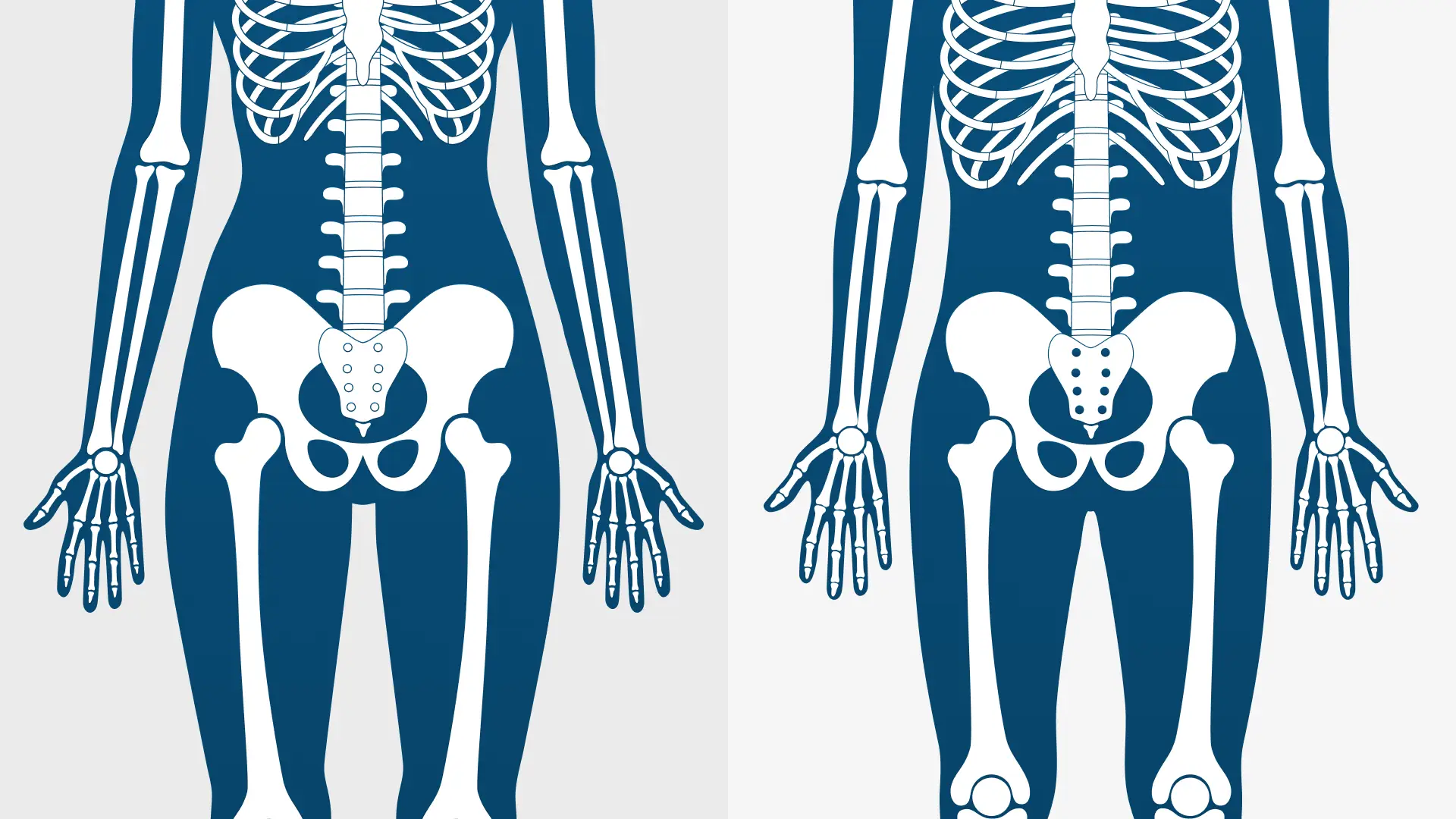
Women tend to have wider hips than men. That means the thigh bone slopes inwards a little more on its way down to the knee. Doctors call this the Q-angle. The wider that angle, the more the kneecap gets pulled towards the outside of the knee as the leg straightens. It sits slightly off centre, so pressure builds where the kneecap meets the thigh bone. Over years of walking, stairs and squatting, that pressure adds up. It is part of why pain at the front of the knee is so common in women.
The knee ligaments are affected too. The anterior cruciate ligament (ACL) sits deep inside the knee and stops it twisting too far. In women, it tends to be slightly smaller, and the space it runs through is narrower. The muscles around the knee also support it slightly differently on landing from a jump. Together, these differences leave the ligament under more strain. That is part of why women tear the ACL more often than men in sports involving jumping and turning.
The hormones: oestrogen, the menstrual cycle and joint laxity
Oestrogen does far more than regulate the reproductive system. Receptors for it sit in cartilage, bone, ligaments and the lining of the joint. As well as helping maintain cartilage, oestrogen has a mild anti-inflammatory effect on the joint, and it influences how stiff or lax the ligaments are. Some women notice their joints feel slightly looser or more uncomfortable at certain points in the menstrual cycle, when oestrogen levels shift, and studies of ligament laxity across the cycle support that experience.
This hormonal sensitivity becomes most important around menopause, when oestrogen falls and stays low – that is where the osteoarthritis story often begins.
Osteoarthritis: why it affects women differently
Osteoarthritis is the leading cause of long-term knee pain from midlife onwards; around 8.75 million people in the UK have seen a doctor about osteoarthritis. It is often described as wear and tear, but actually osteoarthritis is an active process in which the cartilage that cushions the joint gradually breaks down, the bone beneath it changes, and the joint lining can become inflamed. The result is pain, stiffness (especially first thing in the morning or after sitting still), and sometimes swelling and a grinding sensation. The inflammation and pain often begin well before there is any bone-on-bone contact, which is part of why treatments that calm inflammation can help even when the joint is not severely worn.
Women develop knee osteoarthritis more often, and more severely.
Knee osteoarthritis is more common in women than in men, and the gap widens with age. Women are also more likely to have it in both knees, and to report greater pain and disability for a similar amount of joint damage on a scan. Both Versus Arthritis and NICE recognise this higher burden in women. The reasons are partly the anatomy described above, and partly hormonal. Our dedicated guide to knee osteoarthritis covers the condition itself in more detail.
A non-surgical option for osteoarthritis pain
Osteoarthritis often affects women harder, and the pain can wear you down over time. When exercise, weight management and pain relief have not settled things, there are still options short of surgery. At Joint Pain Practice, Dr Richard Shaffer uses low-dose radiotherapy to ease the inflammation behind osteoarthritis pain, given as a few short, non-invasive sessions.
The menopause connection
The rise in knee osteoarthritis speeds up around the time of menopause. As oestrogen falls, cartilage loses some of the protection it helped provide, bone turnover changes, and many women notice new or worsening aches across several joints, not only the knees. In fact, around half of women experience joint pain or arthritis around the time of menopause. Clinicians increasingly group these joint and muscle symptoms as the musculoskeletal symptoms of menopause. If your knees started complaining in your late forties or fifties alongside other menopausal changes, you are not imagining it, and you are far from alone.
Where HRT fits in
Because oestrogen is involved, a common question is whether hormone replacement therapy (HRT) helps joint pain. The honest answer is that the evidence is mixed. Some women on HRT report that aches and stiffness improve, and there is a biological reason to expect an effect on joint tissue, but HRT is not licensed as a treatment for osteoarthritis, the research findings are inconsistent, and whether to use it depends on your wider health and menopausal symptoms. If joint pain is part of a broader picture of menopause, it is worth raising with your GP or a menopause specialist, who can weigh the benefits and risks for you personally.
Whether knee osteoarthritis can be reversed
Cartilage does not grow back once it is lost, so osteoarthritis cannot be cured or reversed. That sounds bleak, but it is not the whole picture. The pain and stiffness of osteoarthritis often respond well to exercise, weight management, and the right pain relief, and many women stay active and comfortable for years. The goal of treatment is to control symptoms and protect function, and that goal is realistic.
The common causes of knee pain in women, by life stage
Knee pain is a symptom, not a diagnosis, and the likeliest cause depends a great deal on age and activity. Grouping the causes by life stage is more useful than a long undifferentiated list, because it points you and your GP towards the right answer faster.
Younger and active women
Patellofemoral pain syndrome is the classic cause of aching at the front of the knee in younger women, around or behind the kneecap, and typically worse on stairs, when squatting, or after sitting for a long time (sometimes called cinema knee).
Ligament injuries, particularly to the ACL, are more common in women who play football, netball, basketball, ski or do similar sports. The mix of joint anatomy, hormonal influence on ligament laxity and landing mechanics raises the risk. These injuries tend to be sudden, with a pop at the time, rapid swelling and a knee that feels unstable. Meniscus tears come in two forms: a traumatic tear during a twisting injury, common in sport, and a degenerative tear that develops slowly as the cartilage weakens with age, often alongside early osteoarthritis, and can cause catching or locking without any single injury.
Midlife and beyond
Osteoarthritis is a major cause of knee pain from the forties onwards, and it’s the single most important cause of persistent knee pain in women over fifty.
Rheumatoid arthritis is an autoimmune condition in which the immune system attacks the joint lining. It is around three times more common in women than men and often starts between thirty and fifty. Unlike osteoarthritis, it tends to affect joints on both sides symmetrically, causes morning stiffness that lasts more than an hour, and can come with fatigue and feeling generally unwell. It needs early specialist treatment, so it should never be dismissed as ordinary ageing of the joint.
Gout, long thought of as a male problem, becomes more common in women after menopause and can strike the knee with sudden, intense pain, redness and swelling.
Soft-tissue problems can affect women at any age and usually settle with rest, sensible load management and physiotherapy. These include bursitis (inflammation of the small fluid-filled cushions around the knee), iliotibial band syndrome (pain on the outer side of the knee, common in runners), and tendonitis.
Weight and pregnancy, at any age
Body weight has an outsized effect on the knee, because the joint carries several times body weight with every step, and more again when going up and down stairs. Carrying extra weight increases the risk of developing painful osteoarthritis. On the other hand, even modest weight loss can significantly reduce the pain in your knee.
Pregnancy can bring on knee pain, and it is rarely discussed. Rapid weight gain, a shifting centre of gravity, and the hormone relaxin, which loosens ligaments in preparation for birth, all change how the knee is affected. Most pregnancy-related knee pain settles after delivery, but it can be a problem while it lasts and is worth managing with supportive footwear, sensible activity, and advice from a midwife or physiotherapist.
Osteoarthritis and osteoporosis: two different conditions
These two are easily confused, because the names sound alike and both are more common in women after menopause, but they are different problems. Osteoarthritis is a joint condition: it causes pain and stiffness in the knee itself. Osteoporosis is a bone-density condition: it thins and weakens bones throughout the body, usually causes no symptoms at all until a bone breaks, and does not in itself cause knee pain. A woman can have both at once. If you are being investigated for one, it is reasonable to ask whether your bone health should be checked too, particularly after menopause, since the same drop in oestrogen affects bone density. A bone-density (DEXA) scan assesses osteoporosis; it does not diagnose osteoarthritis.
Symptoms, and the warning signs that need a GP or specialist
Most knee pain is mechanical and improves with self-care, and the pattern of symptoms gives useful clues. Pain and stiffness that are worse in the morning and ease with movement point towards osteoarthritis. Pain at the front of the knee on stairs points towards a cause just behind the kneecap. Sudden swelling after a twist suggests a ligament or meniscus injury. Symmetrical stiffness lasting over an hour in the morning, along with generally feeling tired, suggests an inflammatory arthritis. None of these is a substitute for a proper assessment, but they help you describe what is happening.
Some symptoms need prompt attention rather than watchful waiting. Seek urgent advice by calling NHS 111 or attending urgent care if you have any of the following:
- A knee that looks deformed after an injury
- Being unable to bear any weight on the knee
- A knee that is hot and swollen with a high temperature, which can occasionally signal an infected joint that needs same-day treatment
How knee pain in women is treated
Treatment follows a sensible order, starting with the measures that help most people and carry the least risk, and escalating only if needed. For osteoarthritis in particular, NICE recommends therapeutic exercise and weight management as the core treatment, before and alongside any medication.
Self-care for knee pain in women comes first
Staying active is the single most effective thing for most knee pain, even though resting can feel more natural. Low-impact exercise such as walking, cycling and swimming keeps the joint moving and the muscles strong without heavy loading. Losing excess weight directly reduces the stress on the joint. Supportive, cushioned footwear helps, and a short spell of ice or heat can ease a flare: ice for a hot, swollen knee, heat for stiffness.
Exercises that help, and what to avoid
Strengthening the muscles around the knee and hip takes pressure off the joint. The quadriceps at the front of the thigh, the gluteal muscles at the hip, and the hamstrings all matter. A physiotherapist can design a programme around you, and in most of England, NHS physiotherapy can be accessed without a GP referral (see below). Build strength gradually. A manageable ache while you build up is normal and not harmful, but sharp or worsening pain during or after exercise is a sign to ease off and seek advice.
Diet, supplements and inflammation
No diet cures knee pain, but two things are worth knowing. First, reaching and keeping a healthy weight is the dietary change with the clearest benefit for the knee. Second, a balanced diet with plenty of vegetables, oily fish and wholegrains supports general joint and bone health. Glucosamine and chondroitin supplements are popular, but the evidence that they reduce osteoarthritis pain is weak and NICE does not recommend them. They are unlikely to harm you, but do not expect too much benefit.
Medication
When pain relief is needed, a topical anti-inflammatory gel rubbed into the knee is recommended first for knee osteoarthritis, because it works locally with few side effects. Paracetamol helps some people. Oral anti-inflammatory tablets (NSAIDs) can be effective, but they carry stomach, kidney and heart risks, so they are used at the lowest effective dose for the shortest time, and with caution in older women or anyone with other health conditions. A pharmacist or GP can advise on what suits you.
Injections
A steroid injection into the knee can reduce inflammation and pain for a period of weeks to a few months, which can help during a bad flare or to allow rehabilitation to get going. The effect is temporary, and these injections should not be repeated more than two or three times as they can actually harm the joint in the end. You may also see clinics offering PRP (platelet-rich plasma), stem cell therapy or prolotherapy for knee osteoarthritis, but the current evidence does not support their routine use for knee osteoarthritis; NICE does not recommend them as standard care, and they are usually only available privately at high cost. Any clinic offering them should explain honestly what is and is not known, rather than promising results.
Low-dose radiotherapy for osteoarthritis
There is a non-surgical option that sits between conservative care and joint replacement, and many people have never been offered it or even heard of it: low-dose radiotherapy. It uses very low doses of targeted radiation to calm inflammation within the affected joint, which can ease pain and stiffness and make the knee more comfortable to move. It is non-invasive, needs no surgery or general anaesthetic, and is usually given as around six short sessions over a couple of weeks, with minimal side effects. You can read more about low-dose radiotherapy for osteoarthritis and how it works.
The treatment has been used across parts of Europe for decades, and the evidence base is strongest for the knee. In one large analysis of 970 patients, pain scores fell from 66 to 44 out of 100, with about two-thirds of treated joints improving, and a randomised controlled trial reported in 2025 found better pain and function compared with a placebo course. The full evidence is set out in our summary of low-dose radiotherapy for knee osteoarthritis.
A few points matter particularly for women. Low-dose radiotherapy does not regrow cartilage or stop osteoarthritis progressing, so it is not a cure; it targets the pain and inflammation. It is generally considered after people have tried exercise, weight management and medication. It’s also particularly helpful for women who want to avoid surgery or are not ready for it.
Because it is non-invasive and can treat more than one joint, it can suit older women who have osteoarthritis in several joints at once and would rather not face the recovery that surgery involves. Around three in four people who have not found relief from exercise, weight loss or medication report benefit, and a good clinic will tell you honestly whether it is likely to help you and point you towards other options if it is not. We’ve also written about who benefits most from the treatment.
Surgery
Surgery is a last resort, considered when symptoms are severe and quality of life is affected despite proper non-surgical treatment. For advanced osteoarthritis, knee replacement (partial or total) is a well-established operation that reliably reduces pain and restores function for most people, though recovery takes months and, like any surgery, it carries risks. In particular, around 15 to 20 per cent of people still experience pain at two years after a knee replacement.
Protecting your knees for the long term
Whatever the cause, a few habits really help over the years. Keep moving, because strong muscles and a mobile joint protect the knee better than rest does. Keep your weight in a healthy range to reduce load. Vary your activity to avoid repetitive overload, and build up anything new gradually rather than in sudden jumps. Choose footwear that supports and cushions, and replace worn trainers. Address pain early rather than pushing through it for months, because small problems are easier to sort out than entrenched ones. None of these things seems dramatic, but done consistently they make a real difference.
Getting help in the UK: the NHS route and when private care helps
Knowing the practical steps matters as much as understanding the causes. Here is how knee pain is usually managed in the UK, and where a private assessment can add value.
The NHS pathway
For most people, the first step is self-care and, if it does not settle, you should see your GP. Alternatively, a useful and often overlooked option is that NHS physiotherapy can be accessed directly in most of England through self-referral, without waiting to see a GP first. For suspected osteoarthritis, NICE guidance steers care towards exercise, weight management and topical or oral pain relief before anything more invasive. If symptoms persist or a firm diagnosis is needed, the GP can arrange an X-ray or refer you onward to a musculoskeletal (MSK) service, to rheumatology if an inflammatory cause such as rheumatoid arthritis is suspected, or to orthopaedics if surgery is thought to be an option.
When a private assessment can help
Private care usually means a faster appointment, quicker access to imaging such as MRI, and continuity with a single named consultant from assessment through to any treatment, rather than being passed between services. It can also help you access options that are not available on the NHS, such as low-dose radiotherapy. For a woman who wants a clear answer quickly, or who has had ongoing knee pain without a firm diagnosis, that can be worth it.
How to choose a clinic
If you do go privately, a few questions help you choose well. Is the consultant on the GMC specialist register for the relevant field, such as orthopaedics, rheumatology or radiotherapy (“clinical oncology”)? Will you see the same doctor throughout? Is the clinic transparent about costs and honest about what each treatment can and cannot achieve? A trustworthy clinic helps you make the best decisions – it does not pressure you.
Frequently asked questions
Why do women get more knee pain than men?
Mostly because of anatomy and hormones. A wider pelvis gives women a larger angle at the knee, which loads the kneecap differently, and oestrogen affects the cartilage and ligaments. Together, these make several knee problems, including osteoarthritis, more common in women.
Can the menopause cause knee pain?
The drop in oestrogen during menopause is linked to more joint aches and a faster rise in knee osteoarthritis. These joint and muscle symptoms are increasingly recognised as part of the musculoskeletal symptoms of menopause. If they are troubling you, it is worth speaking to your GP.
What is the most common cause of knee pain in women?
It depends on age. In younger, active women, pain at the front of the knee (patellofemoral pain syndrome) and sports-related ligament or cartilage injuries are most common. From midlife onwards, osteoarthritis is the leading cause.
Is knee pain in women always a sign of arthritis?
No. There are many causes, including mechanical and soft-tissue problems that have nothing to do with arthritis. Osteoarthritis and rheumatoid arthritis are two possibilities, and the pattern of symptoms helps tell them apart from other causes.
Does low-dose radiotherapy work for knee osteoarthritis?
For many people, yes. Low-dose radiotherapy uses targeted low-dose radiation to calm inflammation in the joint, and the evidence is strongest for the knee, where studies report meaningful reductions in pain. It does not cure osteoarthritis or regrow cartilage, and it is not right for everyone, so it is usually considered after trying exercise, weight management and medication.
When should I see a doctor about knee pain?
See a GP if the pain is severe, has not improved after a few weeks of self-care, or comes with locking, giving way, significant swelling, or a hot red joint with a fever. Seek urgent advice after a significant injury or if you cannot put weight on the knee.
Get a clear answer on your knee pain
Knee pain in women has many causes, and the right treatment starts with the right diagnosis. At Joint Pain Practice, you see Dr Richard Shaffer, a consultant who assesses your knee, explains what is driving the pain, and talks you honestly through every option, from conservative care to low-dose radiotherapy for osteoarthritis. If knee pain is affecting your daily life.