If you have knee osteoarthritis, you have probably already been through the standard pathway. You may have seen your GP, done physiotherapy, worked on exercises, and used pain relief. These are important first steps, and for some people they are enough, but for many the pain continues to affect walking, stairs, and everyday life.
At that point, the main problem is not just the pain itself. It is that you are no longer sure what the next step should be. You are not at the stage where surgery is necessary, but continuing with the same treatments is not giving you enough relief either.
The Real Issue: A Gap Between Early Treatment and Surgery
Most care pathways for knee osteoarthritis focus on two ends of the spectrum. At one end, there are simple treatments such as physiotherapy, exercise, and medication. At the other end, there is knee replacement surgery, which is mainly used for very advanced disease when other options have been exhausted.
What is often missing is a clear plan for the large group of patients in between. Many people spend years in this middle stage, where the pain is limiting but the joint is not yet at the point where surgery is the only option. This creates a situation where patients are left managing symptoms without a clear long-term solution.
Why Many Patients Are Offered Injections – and What the Evidence Shows
At this stage, many patients are offered injections. They are commonly presented as a reasonable next option, but it is important to understand what they actually do and how well they work.
Steroid injections are the most commonly used. They can reduce inflammation and ease pain for a short period, but the effect usually wears off. Repeated injections can make cartilage get thinner, reduce joint space, and speed up further damage, so they are not a good long-term solution.
Hyaluronic acid injections, often called “gel injections” (a common brand name is Ostenil), aim to improve how the joint moves. Some patients do feel better after them, particularly in earlier disease, but many do not, and overall results are inconsistent.
PRP (platelet-rich plasma) is often described as a more advanced or regenerative treatment. However, results are mixed. Some patients improve, while others notice little or no benefit.
When you look at the research as a whole, the key message is simple. These injections do not reliably give long-lasting improvement, and in some studies they perform no better than placebo. This is why many patients end up trying one injection after another without finding a lasting solution.
There is also a practical issue. Injections are often repeated over time, which adds cost, inconvenience, and uncertainty about whether the next one will help.
What This Feels Like in Practice
In practice, many patients find themselves moving through a sequence of injections without a clear endpoint. There may be some temporary relief, or sometimes none at all, and even when there is improvement it often does not last.
This can lead to a cycle of trying different options without a treatment that provides sustained benefit. In addition, injections involve needles into the joint, and while routine, they are still invasive and not something patients usually want to keep repeating.
Surgery Is Mainly for End-Stage Disease
Knee replacement surgery is a very effective treatment, but it is mainly used when the joint is severely damaged and other options are no longer helpful. In other words, it is usually a treatment for end-stage osteoarthritis.
Many patients in this middle stage do not fall into that category. The joint may still have some joint space left, which means there are still other options to consider before moving to surgery. It often makes sense to explore less invasive treatments first.
It is also important to be aware that surgery is not a perfect solution. Around one in five patients still report pain or stiffness afterwards, which is another reason to consider all appropriate options before taking that step.
Schedule an appointment today and discover a new innovative approach to pain management that could
transform your quality of life. Your path to relief starts here!
Low-Dose Radiotherapy: A Non-Invasive Option for This Stage
Low-dose radiotherapy is designed to fit into this gap between early treatments and surgery. It offers a way of treating pain without injections or an operation.
The treatment uses very small doses of radiation, much lower than those used for cancer treatment. At these levels, it works by calming inflammation within the joint rather than damaging tissue.
For patients, the key point is that it provides a different approach. Instead of repeated short-term treatments, it aims for longer-lasting relief without invasive procedures.
What the Evidence Shows for Radiotherapy
Low-dose radiotherapy has been used for many years and is supported by large patient series involving thousands of people. Across these studies, around 70 to 80 percent of patients report improvement in pain.
More recently, three randomised trials in knee osteoarthritis have shown that radiotherapy improves pain and function compared with control treatments. This strengthens the evidence and shows that the effect is real, not just anecdotal.
There is also evidence suggesting that radiotherapy may slow the progression of osteoarthritis over time, rather than just reducing symptoms. This is an important difference from injections, which are mainly short-term treatments.
What Treatment Is Actually Like
One of the most common concerns patients have is what the treatment involves. In reality, it is simple and straightforward.
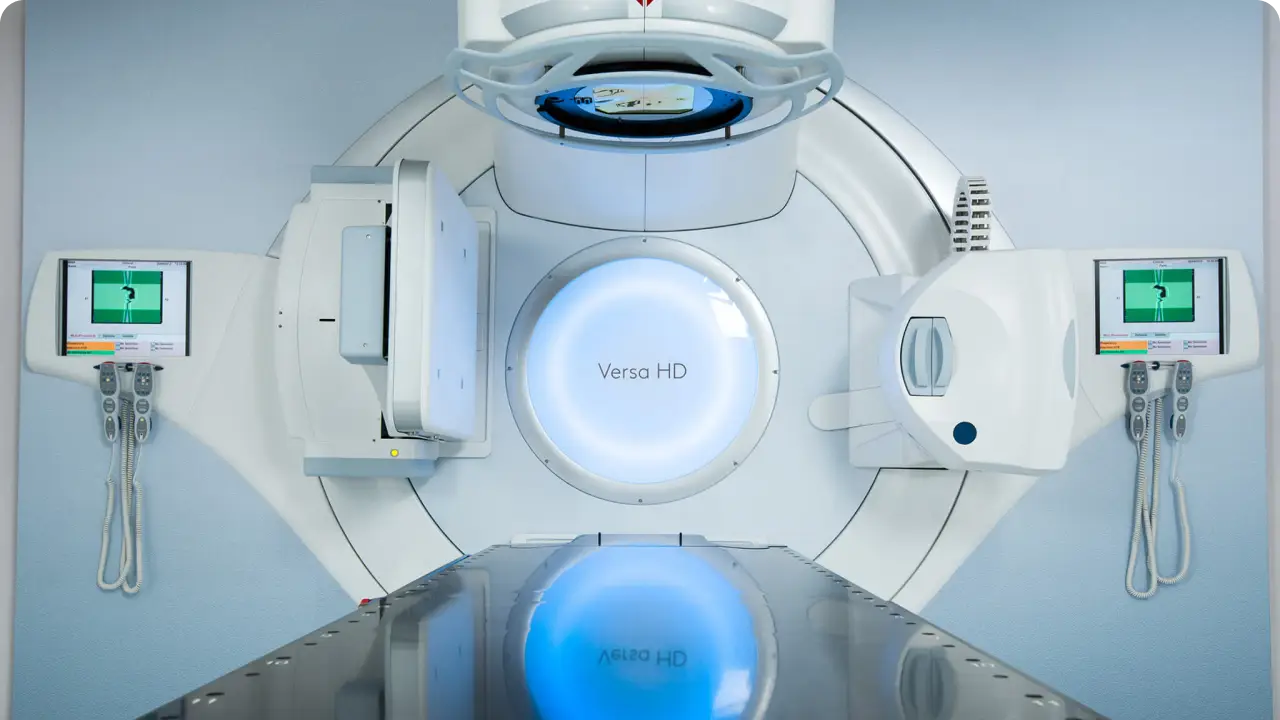
Radiotherapy for osteoarthritis is done as an outpatient. You attend the department, lie on a treatment couch, and a machine moves around you, similar to having a scan.
Each session takes about ten minutes and is completely painless. There are no injections, no discomfort, and no side effects such as nausea, tiredness, or dizziness. You can drive yourself home and continue normal daily activities straight away.
A typical course consists of six treatments over two weeks, usually on a Monday, Wednesday, and Friday schedule.
Who This Treatment Is Suitable For
This treatment tends to work best if there is still some joint space remaining and you have ongoing pain despite physiotherapy and medication. It is often a good option if you are not at the stage where surgery is necessary but want something more effective than conservative treatments.
If the joint is completely worn out, often described as “bone on bone,” the chance of success is much lower. In that situation, surgery is usually the more appropriate treatment.
It Is Important to Understand Your Options Properly
If you still have knee pain after physiotherapy and medication, and surgery is not necessary at this stage, there are several options available. The challenge is understanding how they compare, so you can decide what is right for you.
Having a clear picture of the benefits, limitations, and risks of each treatment helps you make a more informed decision about what to do next. This is especially important in osteoarthritis, where decisions are often made over time rather than all at once.
If You Want to Explore This Further
If you still have knee pain and are unsure what the next step should be, the most useful next step is a proper assessment. This involves reviewing your symptoms, examining your knee, and looking at imaging such as X-rays or MRI scans.
If you would like to explore whether low-dose radiotherapy could help in your situation, you can get in touch to discuss it further.
References