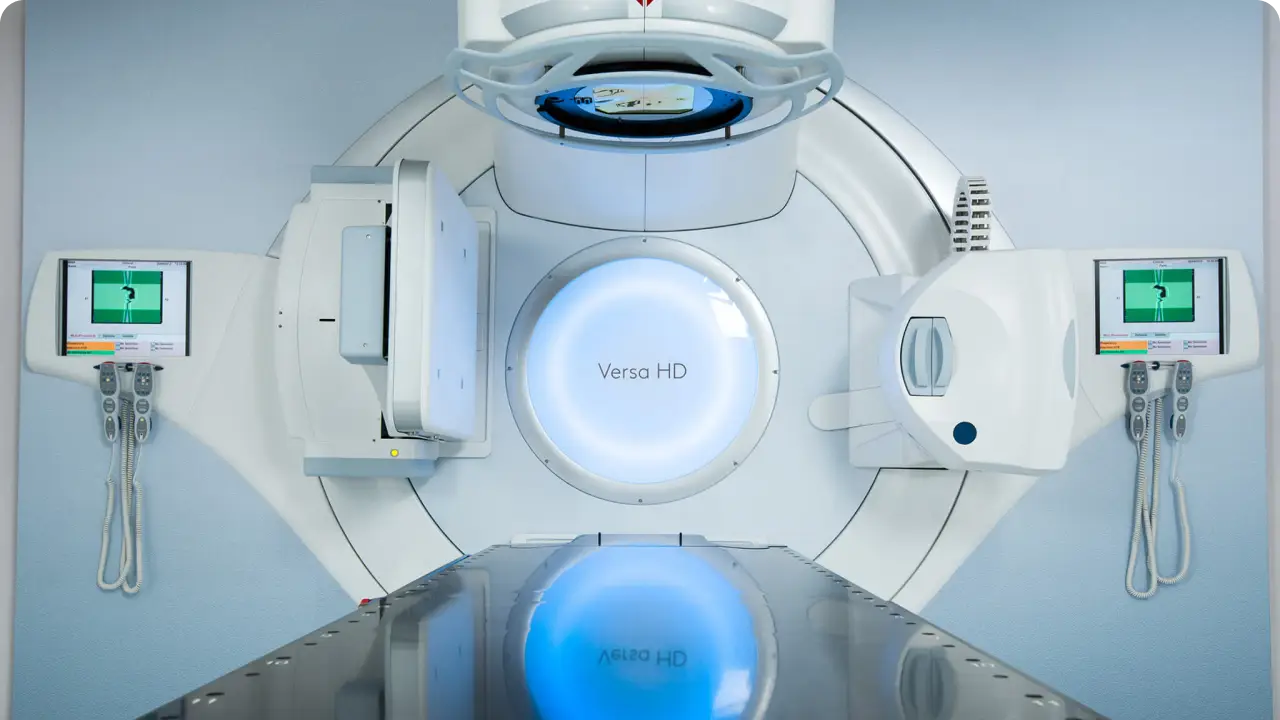

If you’ve been researching treatments for knee osteoarthritis, you may have come across low-dose radiotherapy and wondered whether it genuinely works or whether it sits somewhere on the fringes of medicine.
That’s a reasonable question.
Most people associate radiotherapy with cancer treatment, not arthritis. The idea of using radiation to treat knee pain can sound surprising at first, and many patients understandably want to know whether there is real scientific evidence behind it before considering it as an option.
The short answer is yes. Low-dose radiotherapy has been used to treat painful osteoarthritis for many decades, particularly in Germany and other parts of Europe1. More importantly, the evidence supporting it has become considerably stronger in recent years.
Who Is Most Likely To Benefit?
Before looking at the evidence, it’s important to understand who radiotherapy is designed for.
In general, the best results are seen in people with mild-to-moderate knee osteoarthritis. On X-rays, this usually corresponds to Kellgren-Lawrence grade 2 or grade 3 disease.
These are often people who:
- Have ongoing knee pain despite physiotherapy, exercise programmes or other conservative treatments.
- Find that pain is limiting walking, climbing stairs, sports or normal daily activities.
- Are not yet ready for a knee replacement.
- Want to explore alternatives before moving on to more invasive treatments.
Radiotherapy is generally less effective in very advanced, end-stage arthritis where there is little or no joint space remaining. In those situations, knee replacement surgery is often the more appropriate option.
Where Does Radiotherapy Fit Among Other Treatments?
Radiotherapy is not intended to replace exercise, weight management or physiotherapy.
These remain important parts of osteoarthritis treatment and often continue alongside radiotherapy.
Instead, radiotherapy usually sits in the middle ground between conservative measures and surgery. Some patients choose it before injections. Others consider it after injections have provided only temporary relief. Many people are simply looking for an option that may improve pain and function without the risks, recovery time and commitment involved in a knee replacement.
What Does The Overall Evidence Show?
The strongest evidence does not come from a single study. It comes from looking at the entire body of research.
Across published studies involving thousands of patients with osteoarthritis in different joints, around 70-80% of patients report meaningful improvements in pain and function following low-dose radiotherapy1. Knee osteoarthritis is one of the most extensively studied conditions within the literature.
While individual studies vary in their results, the overall pattern has been remarkably consistent. Many patients experience reduced pain, improved mobility and a better ability to carry out normal daily activities.
The question that researchers have been trying to answer more recently is whether these improvements hold up when radiotherapy is tested in the most rigorous type of study: a randomised controlled trial.
What Have The Randomised Trials Found?
For many years, critics pointed to a Dutch study published in 2018 that found no significant difference between radiotherapy and placebo treatment2,3.
That study remains important and should not be ignored. However, it is no longer the only randomised trial available.
Since then, several newer randomised studies have been published. These have compared low-dose radiotherapy against placebo treatment and have generally shown improvements in pain and function among patients receiving radiotherapy4,5,6,7.
As a result, the overall picture today looks very different from what it did a few years ago. Rather than one isolated negative study, we now have multiple randomised trials suggesting that low-dose radiotherapy can provide a genuine benefit for appropriately selected patients.
That doesn’t mean it works for everyone. No osteoarthritis treatment does. But it does mean that there is now a growing body of high-quality evidence supporting its use.
Can Radiotherapy Do More Than Reduce Pain?
This is where the research becomes particularly interesting.
Most osteoarthritis treatments focus on symptoms. They aim to reduce pain, improve movement or help people cope better with their arthritis.
What they do not usually claim to do is alter the underlying disease process.
More recent research has raised the possibility that low-dose radiotherapy may be different.
In a long-term randomised study involving patients with early-to-moderate knee osteoarthritis, researchers found not only improvements in pain and physical function but also evidence that the joints themselves appeared to deteriorate more slowly over time.
MRI scans showed less cartilage loss, less bone marrow oedema, less osteophyte formation and less progression of several other structural features associated with osteoarthritis. The benefits persisted over many years of follow-up.
Even more strikingly, longer-term follow-up suggested lower rates of disability and fewer knee replacements in some groups of patients who received radiotherapy compared with those who did not7.
These findings are still being explored and confirmed, and more research is needed. However, they raise an important possibility: that low-dose radiotherapy may not simply mask symptoms but could potentially influence the biological processes driving osteoarthritis progression.
If future studies confirm these findings, it would represent a significant shift in how we think about treating arthritis.
Why Might Radiotherapy Help Osteoarthritis?
Osteoarthritis was once viewed simply as “wear and tear.”
We now know the picture is more complicated.
Inflammation plays an important role in many patients, particularly within the lining of the joint and surrounding tissues. Low-dose radiotherapy appears to influence several inflammatory pathways and immune cells involved in this process.
The doses used are far lower than those used to treat cancer. Rather than destroying tissue, the aim is to reduce abnormal inflammatory activity within and around the joint.
This is why low-dose radiotherapy is sometimes described as an anti-inflammatory treatment rather than a destructive one.
Is Radiotherapy For Knee Osteoarthritis Safe?
Safety is understandably one of the biggest concerns patients have.
The radiotherapy used for osteoarthritis is very different from the radiotherapy used to treat cancer.
Cancer treatments often involve total doses of 50-70 Gray or more. Osteoarthritis treatment typically uses around 3 Gray in total, delivered over six short treatment sessions.
The treatment itself is painless.
There is no anaesthetic, no hospital stay and no recovery period. Most patients continue their normal daily activities throughout treatment.
Short-term side effects are uncommon and are usually mild if they occur at all.
The main concern people raise is the possibility of developing cancer in the future because of the radiation exposure. Based on current evidence, this risk is believed to be very small. While no medical treatment can ever be described as completely risk-free, the doses involved are extremely low, and the estimated long-term risk appears to be far lower than many patients initially assume.
So, Does It Work?
Based on the evidence available today, the answer is that low-dose radiotherapy appears to help many patients with knee osteoarthritis.
Large published series involving thousands of patients report improvement rates of around 70-80%.
Several modern randomised trials have demonstrated benefits in pain and function compared with placebo treatment.
Emerging long-term data suggest that radiotherapy may also slow structural joint deterioration and reduce disability over time, although further research is ongoing.
It is not a cure for osteoarthritis, and it will not help every patient.
However, for people with mild-to-moderate knee osteoarthritis who continue to struggle despite conservative treatment and are not yet ready for knee replacement surgery, it represents a legitimate, evidence-based treatment option that deserves consideration.
Thinking About Whether You Might Be Eligible?
If you have ongoing knee pain from osteoarthritis and want to understand whether low-dose radiotherapy might be appropriate for your particular situation, an assessment can help clarify where you are in the treatment pathway and whether you are likely to benefit.
References
- DEGRO guidelines: S2e Guideline – Radiotherapy of Benign Diseases (English)
- Dutch trial (Mahler 2018): Mahler et al. Effectiveness of low-dose radiation therapy on symptoms in patients with knee osteoarthritis: a randomised, double-blinded, sham-controlled trial. Ann Rheum Dis 2019;78:83–90.
- Ott OJ, Micke O, Mücke R, Niewald M, Rödel F, Schäfer U, Seegenschmiedt MH, et al.; German Cooperative Group on Radiotherapy for Benign Diseases (GCG-BD). “Low-dose radiotherapy: Mayday, mayday. We’ve been hit!” Strahlentherapie und Onkologie. 2019;195:285–288. DOI: 10.1007/s00066-018-1412-1
- Arthrorad trial (Niewald 2021): ArthroRad trial: multicentric prospective and randomized single-blinded trial on the effect of low-dose radiotherapy for painful osteoarthritis depending on the dose, results after 3 months’ follow-up. Strahlenther Onkol 2021.
- Iranian trial (Fazilat-panah 2025): Fazilat-panah et al. Effects of low dose rate radiotherapy on pain relief, performance score, and quality of life in patients with knee osteoarthritis; a double-blind sham-controlled randomized clinical trial. International Journal of Radiation Biology. DOI: 10.1080/09553002.2025.2473975
- South Korean trial (Kim et al., ASTRO presentation, 2025): Clinical effectiveness of single-course low-dose radiation therapy in knee osteoarthritis.
- Russian trial (Makarova 2019): Orthovoltage X-ray therapy in the treatment of patients with gonarthritis 0-2 stage: long-term results of a randomized trial. Pain syndrome dynamics. Diagnostic Radiology and Radiotherapy 2019 [in Russian].