
If you're looking for osteoarthritis treatment in London, The Joint Pain Practice runs its flagship clinic at the Cromwell Hospital in South Kensington. Patients across central London, Greater London and the Home Counties come here for consultant-led low-dose radiotherapy, a proven non-surgical option for ongoing joint pain. Every consultation is with Dr Richard Shaffer, a UK-leading specialist in this treatment, and the focus throughout is on settling pain, restoring movement and avoiding surgery.
By Dr Richard Shaffer
No surgery, no general anaesthetic
Low-dose therapy
Treatment delivered at Cromwell Hospital, SW5
For Londoners living with osteoarthritis, the choices have often felt limited. Repeated steroid injections give short-term relief but lose their effect over time and may worsen joint health, while joint replacement surgery means weeks away from work and a long recovery. Low-dose radiotherapy fills the gap between those two paths. It targets the inflammation driving the pain, can be completed within two weeks, and lets you walk out of the hospital and carry on with your day. Three points set this approach apart:
Low-dose radiotherapy works on the joint itself, calming the immune cells responsible for ongoing inflammation rather than masking the symptoms. Around 10 million people in the UK have arthritis, and a growing share of them are looking for something that sits between an injection and an operation.
Dr Shaffer has personally treated thousands of osteoarthritis patients and trained other UK consultants now offering this therapy. He serves as President of the International Organisation for Radiotherapy for Benign Conditions, the global body setting standards for this type of treatment.
Cromwell Hospital is the largest of our four consultation centres, alongside Wimbledon, Guildford and Nottingham. Once your treatment plan is agreed, you can have the radiotherapy delivered here in Kensington or at any of our 15 UK centres if a different location works better for your routine.
Low-dose radiotherapy has been used in Germany and other parts of Europe for benign inflammatory conditions for decades. The dose used is a small fraction of what's given for cancer treatment, calibrated to settle the overactive immune response in the joint without affecting the surrounding tissue.
Each course involves six brief sessions over two weeks. There's no anaesthetic, no needle going into the joint, and no recovery period to plan around. Most patients walk into the hospital, are treated within a few minutes, and head straight back to work, the gym, or whatever the rest of the day holds. The pain relief is gradual, with most people noticing real improvement in stiffness and discomfort over the first two to three months.
The clinical evidence is strong. A 2021 multicentre analysis tracking l970 elderly patients across 1,185 treated joints found pain scores fell from 66 at baseline to 44 at follow-up after low-dose radiotherapy. with the improvement holding steady regardless of patient age. For patients who've already worked through physiotherapy, painkillers or steroid injections without lasting results, low-dose radiotherapy is often the missing middle option.
Your first appointment will be a face-to-face review with Dr Shaffer in the GenesisCare radiotherapy unit at Cromwell Hospital. He'll go through your history, look over any X-rays, MRI scans or recent letters from your GP or specialist, and examine the affected joint. From there, he'll explain whether low-dose radiotherapy is a good fit for you and what the course would look like in practical terms. Consultations usually last around 30 minutes, and a clear written summary goes to you and your GP within a week.
A standard course is six sessions, typically delivered across two weeks. The actual treatment time per session is only a few minutes, and most patients are in and out of the unit within half an hour, including check-in. There's no downtime afterwards, so plenty of patients book sessions in their lunch break and head straight back to the office.
That's the situation many of our patients find themselves in. People who've already tried painkillers, physio, hyaluronic acid or steroid injections without lasting relief are often the best candidates for low-dose radiotherapy. You don't need to have failed every other option first, though. Some patients prefer to skip steroid injections altogether and try this route earlier.
A GP referral isn't required if you're paying for the consultation yourself. If you're using private medical insurance, your insurer will usually want a referral letter for the initial appointment. Most London patients self-refer through our enquiry form and forward any previous notes and scan reports once the appointment is booked.
The GenesisCare radiotherapy unit sits on Level -1 of Cromwell Hospital. When you arrive at the main reception on Cromwell Road, let the team at the desk know you're there to see GenesisCare and they'll point you to the right lift. Signage runs throughout the building, and a member of our team is usually waiting to greet you when you step out on Level -1.
Most patients having low-dose radiotherapy for osteoarthritis are self-funding, because insurance coverage for this specific treatment is still inconsistent across UK providers and policies. We share full pricing upfront before anything begins, so there are no surprises. If you have private medical insurance, the simplest route is to get authorisation for the initial consultation first, then take the proposed treatment plan back to your insurer for a coverage decision.
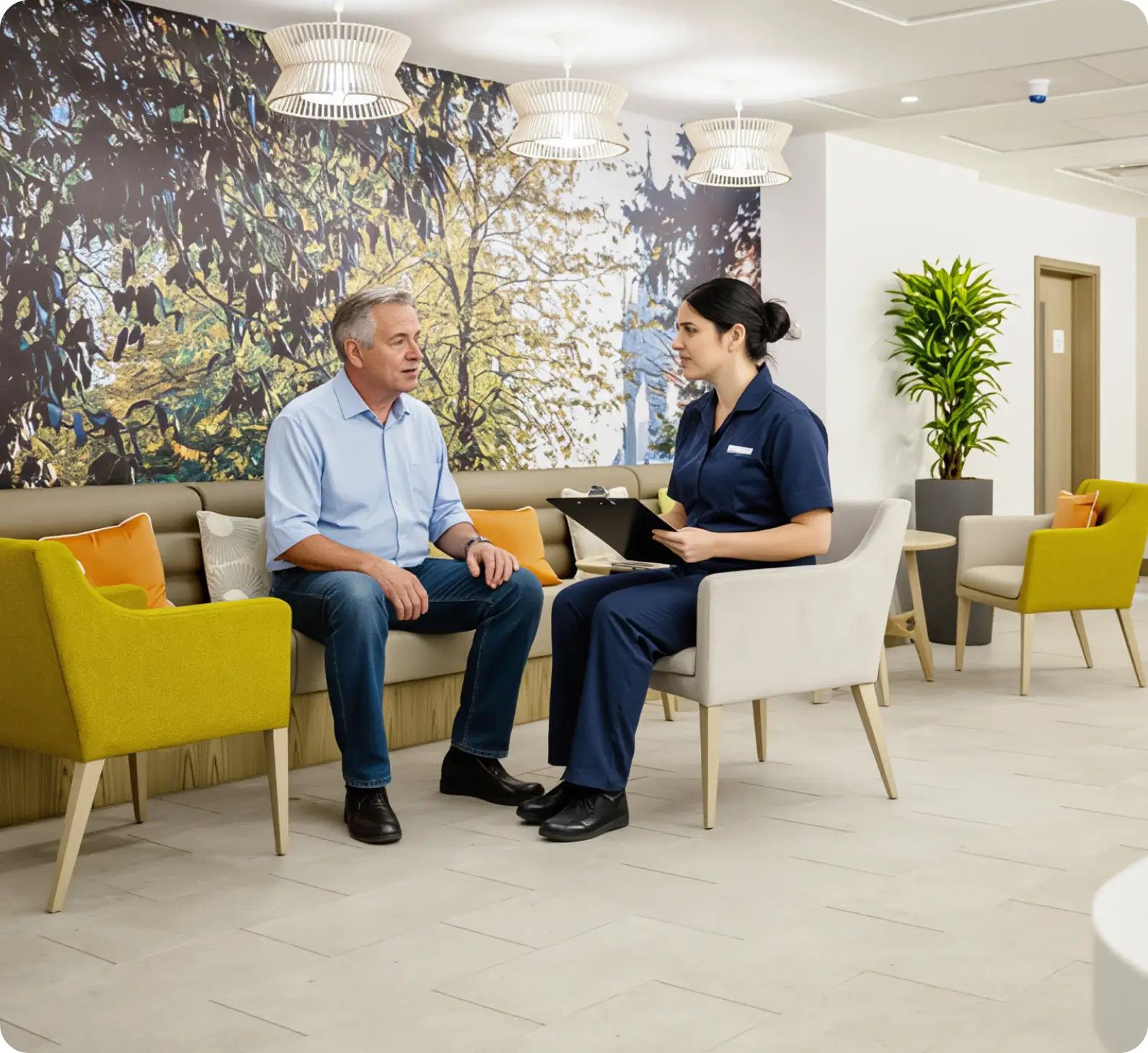
The clearest sense of what treatment at our London centre is actually like comes from people who've already been through it. Below are a few words from patients who chose low-dose radiotherapy at Cromwell Hospital after exhausting other routes.

Dr Shaffer explained the treatment clearly so I had no anxiety before and during treatment.
I think this treatment is a great alternative to surgery.

Within 20 minutes of completing an on line enquiry form Dr Shaffer had called me personally, discussed my condition and made an appointment to see him. I never felt under any pressure and completely trusted his expert opinion. At last somebody who took notice and understood the condition. I would highly recommend his care.

The appointment and then the treatment was prompt and straightforward.
Most importantly, it was painless and appears to have worked!

Dr Shaffer was on-time and dealt with the examination of hands/feet. He was able to rely on records of a prior visit in 2011 to help with diagnosis (that I had lost).
He was able to recommend treatment and courses of action - whether through him or colleagues. He was very helpful.

Treatment is delivered through GenesisCare at Cromwell Hospital, an established private hospital in South Kensington with a dedicated radiotherapy unit on Level -1. The unit is staffed by experienced radiographers, equipped with precise linear accelerators, and designed around making patients comfortable from the moment they walk in.
GenesisCare Radiotherapy Department, Cromwell Hospital, 164 - 178 Cromwell Road, Kensington, London, SW5 0TU
The hospital sits just off the A4 and A3220 in West London. Cromwell Hospital itself is outside the Congestion Charge zone, but depending on which way you're coming from, you may pass through it, so worth checking your route before you set off. Free parking is available at the Sainsbury's at 158a Cromwell Road, SW7 4EJ, around two minutes' walk away. Paid parking is available at the Marriott and the Copthorne Tara Hotel, with metered spaces behind the hospital.
The closest stations are Earl's Court (District and Piccadilly lines, with step-free access), Gloucester Road (Circle and District lines) and High Street Kensington (Circle and District lines). All three are a short walk from the hospital.
Several routes run along Cromwell Road, including the 74, 328, 414 and C1, with stops within a minute or two of the hospital entrance.
Leave your details below, and our team will be in touch to arrange a consultation at a time that suits you.

